
Golf isn't just a swing. It's a succession of decisions.
Volume 1: A reflection on the relationship between body, decision and performance in golf.
Understanding the body.
Decide better.
Playing fairer.
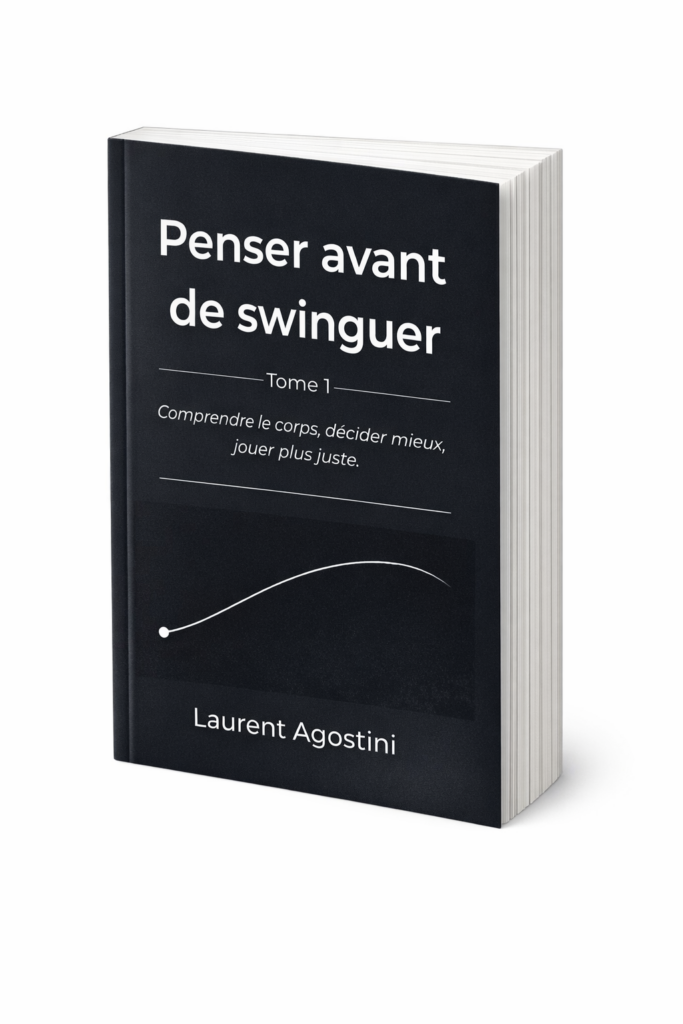
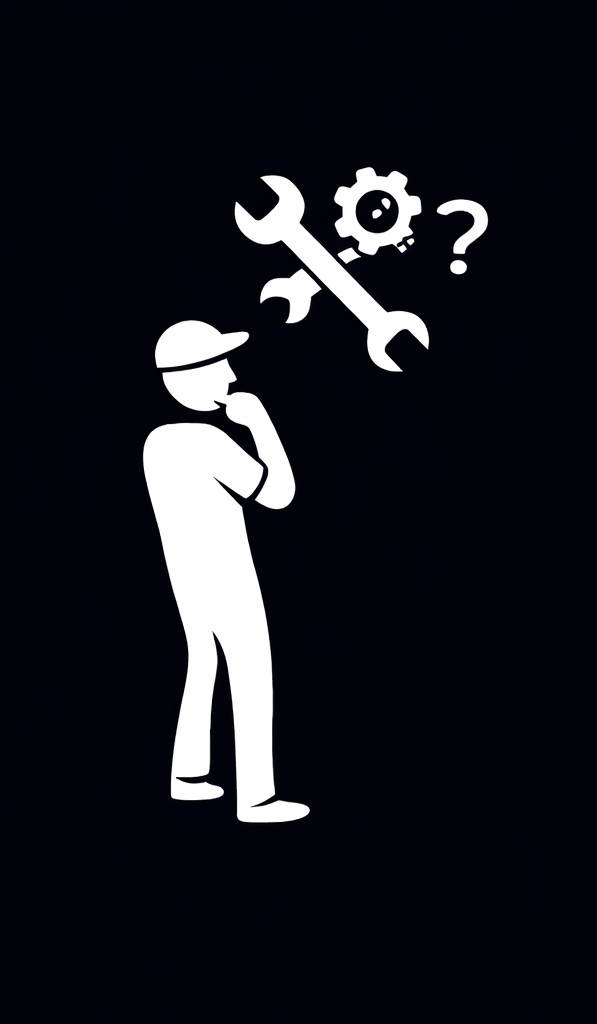
For decades, amateur golfers have been convinced of one thing: to progress, all you have to do is improve your swing. Correct your posture. Adjust your grip. Copy what the pros do.
What if the problem lay elsewhere?
In Think Before You Swing, Laurent Agostini offers a radically different approach to golf. After fifteen years of investigations, interviews and analyses at the heart of world golf, he demonstrates that performance is not based solely on the mechanics of the swing, but on a much more fundamental skill: the quality of the decisions made before hitting the ball.
Choice of trajectory, strategy on the course, biomechanical understanding of the body, mental management of the shot, relationship with the equipment: each chapter explores an often-neglected dimension of the game. The aim is not to teach a perfect swing - because it doesn't exist - but to give players the keys to building a perfect swing. a game system that's consistent with their body type, level and strategic intelligence.
Inspired by the work of researchers, coaches and champions, this book shows why golf doesn't reward mechanical perfection but clear decision-making when it's time to act.
At the crossroads of technique, biomechanics, psychology and strategy, Think Before You Swing proposes a simple but powerful idea:
Before you try to swing better, learn to think better about golf.
Why don't golfers progress?
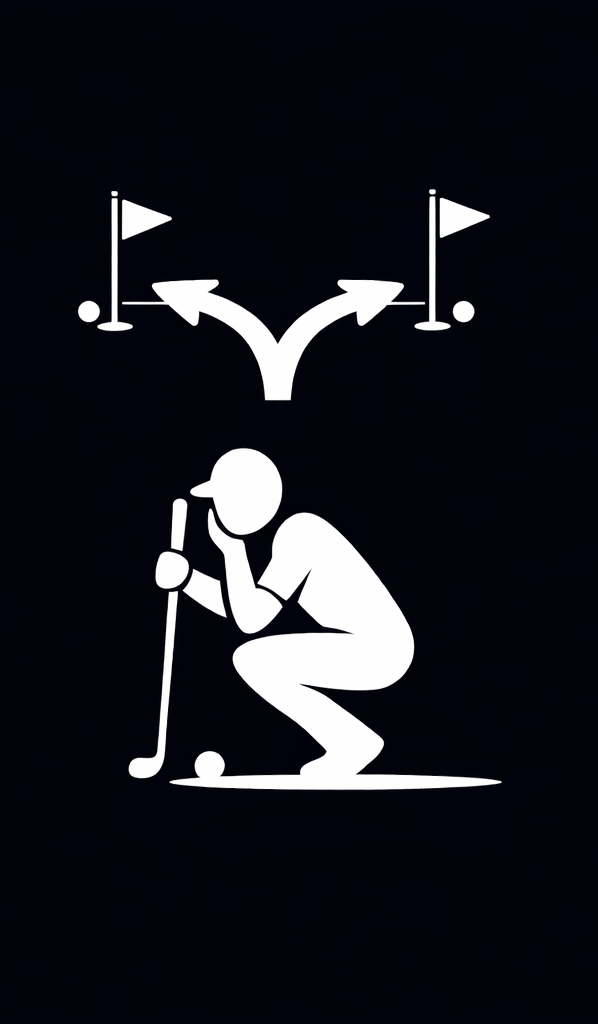
Yet golf is above all a succession of decisions.
What this book offers:
Rather than seeking a perfect swing - which doesn't exist - this book proposes a different approach to golf.
An approach based on 3 fundamental ideas:
Understanding the body
Swing biomechanics explained simply.
Making better decisions
How to analyze a situation on the course.
Playing fairer
Build a playing system consistent with your body and level.
Chapter 1 : Adam Young, or the Art of thinking about golf before trying to “Fix” it
There are coaches you listen to. And then there are those we read. The difference is not anecdotal. To read a coach is to enter into his reasoning. It's about measuring his ability to articulate an idea, to defend it, to nuance it, to link it to something other than the latest hot tip. If I had to single out just one influence in my golfing career - over fifteen years of more or less assumed obsession - Adam Young would be right up there at the top. Not because he promises miracles. On the contrary: because he tackles the most frustrating, and hardest-to-admit, aspect of golf... the fact that you can work hard, sincerely, and still under-perform. Young is one of a generation of teachers who have shifted the focus of teaching: less “positions”, more “results”. Less dogma, more cause and effect. He has built his legitimacy by writing - on his website, in programs, and via a book that has become a reference for many golfers who want to progress without lying to themselves: The Practice Manual - The Ultimate Guide for Golfers.
Excerpt from the first chapter of Penser avant de swinguer - Tome 1
The essential flip-flop: technique and skill are not the same thing
The classic trap of the serious golfer is to confuse two projects. On the one hand, the technique, In other words, the way of doing things (positions, mechanics, alignments, reference points). On the other, the’skill, In other words, the ability to produce a desired result under varying conditions. Young puts it in his own way: skill is the ability to “transform a desired action into a result”. And when you read him properly, you realize that his point is not to reject technique, but to put it in its place: a means, not a trophy.
Sports psychologist Dan Abrahams comes to the same conclusion from another world: technique is a physical task; skill is execution in a game context, i.e. with uncertainty, decision and a form of pressure. And above all: “training in the same place with the same movement” produces a type of skill... more akin to a practice skill than a course skill. This distinction seems abstract. In reality, it explains years of misunderstandings. The “hard-working” amateur golfer often has impeccable discipline: he comes, he hits buckets, he “works on his swing”. And yet, he returns to the clubhouse with the same card, or worse: a deteriorating one. Young poses the vexing question: what if this overly technical approach is precisely what prevents skill from emerging?
The driving range is not the course, and this detail changes everything
On the course, each shot is a unique object: different lies, slopes, wind, intentions, risks, choice of target, consequences. On the practice range, we rehearse in a stable environment, often without any real stakes, and with a mental target that boils down to “hitting it right”. Abrahams proposes a simple example of a “test of skill”: set up a 20-metre-wide fairway, hit 10 balls, aim for 80% of success, then tighten the target or increase the requirement.
The principle is not merely statistical: it imposes a form of pressure, goal-oriented attention and adaptation. Young, for his part, pushes the same logic under the concept of training variability You don't progress so much by repeating “the perfect shot” as by learning to succeed despite imperfection - exactly what the course will ask you to do. This is where it becomes dangerous... for preconceived ideas. Because it removes a comfortable alibi for the golfer: the belief that progress is proportional to the volume of technical repetitions...
This book is for :
About the author
Laurent Agostini has been a golf journalist for over fifteen years.
Founder of the independent media platform MyGolfMedia, he has published more than 5,000 articles dedicated to technique, equipment, and course strategy.
He has interviewed some of the world’s greatest players, including Rory McIlroy, Sergio Garcia, and Phil Mickelson, and has met with executives from leading equipment brands in the United States.
Passionate about swing analysis and equipment research, he has developed testing protocols using technologies such as TrackMan. TrackMan.
After the closure of MyGolfMedia in 2025, he decided to turn fifteen years of observing the game into a series of books.
Think Before You Swing est le premier volume de cette série.
Read his interview with Ouest-France about his previous book on Tiger Woods

My previous book, published in 2018 by Solar.
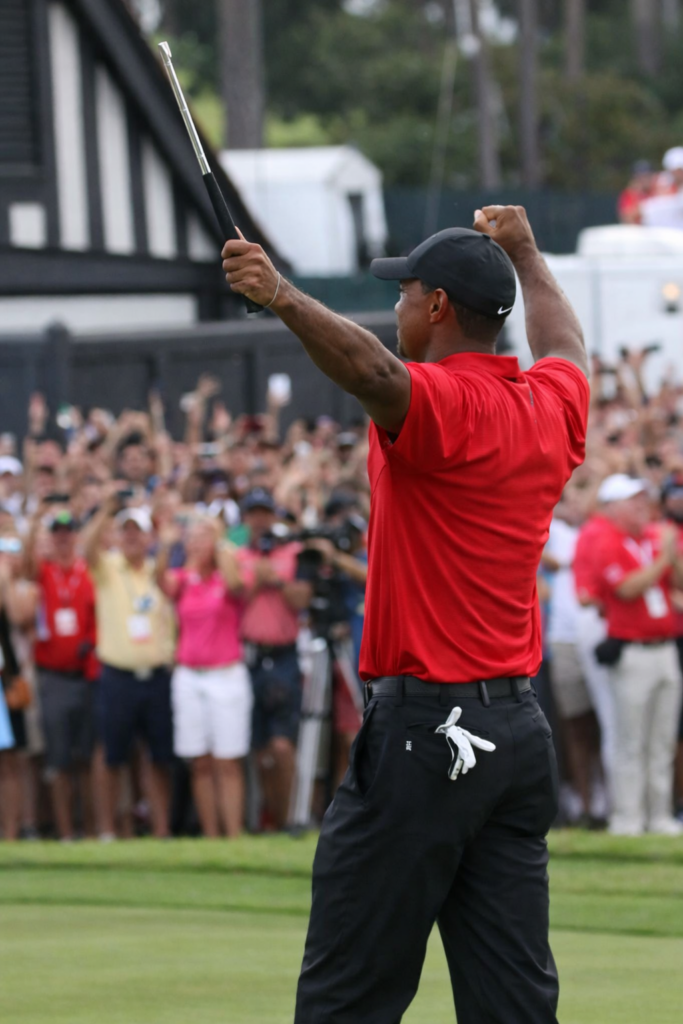
Tiger Woods: The Man Behind the Mask (Solar, 2018)
In 2018, Laurent Agostini published Tiger Woods: The Man Behind the Mask with Solarco-written with journalist Jean-Louis Tourtoulon.
Structured as an investigation, the book explores the many facets of the most famous golfer of the modern era: the prodigy shaped from childhood by his father, the champion who transformed professional golf in the late 1990s, and the man confronted with injuries, personal crises, and unprecedented media pressure.
Through the analysis of his major victories, his complex relationships with coaches, and his status as a global icon, the book seeks to understand what makes Tiger Woods unique: a personality both fascinating and controversial, whose influence extends far beyond the sport.
The book also examines the economic and media dimensions of the Woods phenomenon, as he became one of the wealthiest and most influential athletes in history.
My books on Amazon
Table of Contents – Think Before You Swing
Prologue : Why this book exists
Chapter 1 : Adam Young, or the Art of thinking about golf before trying to “Fix” it
Chapter 2 : Improving: the real equation (and why most golfers misunderstand it)
Chapter 3 : Ball flight before the swing
Chapter 4 : What if your balance profile determines your swing?
Chapter 5 : Magic Wands
Chapter 6 : With the driver, produce an intentional ball flight
Chapter 7 : Aldrich Potgieter, or power stripped bare
Chapter 8 : Hitting the driver farther isn’t always better
Chapter 9 : The body before the club – Biomechanics and Neuroscience of the swing
Chapter 10 : With Irons, think about impact before you produce the swing
Chapter 11 : Scottie Scheffler, or the most unsettling lesson in modern golf
Chapter 12 : Play faster or act efficiently?
Chapter 13 : Hybrids and fairway woods: How to simplify without lying to yourself
Chapter 14 : Aim at greens, not flags
Chapter 15 : Around the greens: where the score is really decided
Chapter 16 : Escaping the bunker: The simple lesson of a generous man
Chapter 17 : Putting through the eyes of those who study the stroke
Chapter 18: The decision before the swing
Epilogue : This book is a beginning